





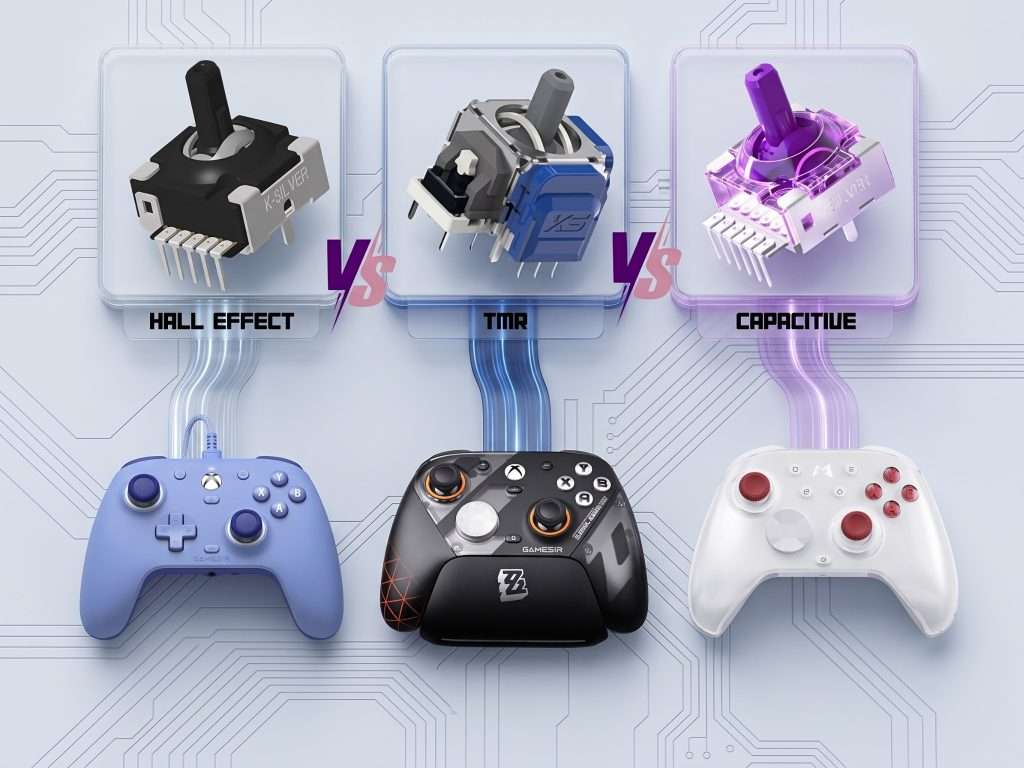
If you have been shopping for a new controller or handheld lately, you have probably noticed joystick tech getting unusually specific. It is no longer just “analogue sticks”. It is Hall effect, TMR, and, in some premium cases, capacitive-assisted designs. For enthusiasts, that sounds brilliant. For everyone else, it raises the obvious question: what actually changes when your thumbs hit the sticks?
This is the short answer: all three approaches are trying to solve the same old problem. Traditional potentiometer sticks wear because they rely on physical contact. Modern alternatives reduce or remove that wear, improve consistency, and aim to keep your aim, steering, and movement feeling the same after months or years of play. The science matters because the feel matters.
Hall effect vs TMR vs capacitive joysticks: the quick answer
If you want the simplest buyer’s guide, it looks like this:
- Hall effect sticks are the proven anti-drift mainstream choice. They use magnets and a sensor to measure movement without a rubbing contact surface. You can find a range of these on the market, from budget to premium options.
- TMR sticks are the newer magnetic option, designed to deliver higher signal sensitivity and lower power draw, with excellent precision potential for competitive play. We’re seeing more controllers featuring these as standard moving through 2026.
- Capacitive joystick systems usually refer to touch-capable or capacitive-assisted control elements, rather than the core positional sensing method used by the stick itself. They can improve how a controller detects thumb contact or interprets interaction, but they are not always a direct substitute for Hall or TMR position sensing.
In practical gaming terms, Hall effect is already excellent, TMR is the enthusiast-forward evolution, and capacitive features are best understood as a smart control layer that can enhance the overall stick system rather than replace magnetic sensing outright.
First, what causes stick drift in the first place?
To understand the difference, you need the failure mode. A conventional analogue stick typically uses a potentiometer: a mechanical contact drags across a resistive track, changing voltage as the stick moves.
Most modern first-party gaming controllers still use this archaic type of mechanism for joysticks, despite hall effect being pioneered by SEGA in 1999 with the Dreamcast controller.
However, the potentiometer stick design persists because it is cheap, familiar, and responsive. The problem with these sticks is they have a wear surface. Over time, repeated movement, dust ingress, microscopic abrasion, and spring fatigue can all nudge the neutral point away from centre.
That is drift. Not magic. Not bad luck. Just tribology, tolerance stack-up, and electrical noise showing up in your reticle.
So the modern solution is elegant: stop relying on physical electrical contact to read the stick position.
How Hall effect joysticks work

A Hall effect joystick uses a magnetic field and a Hall sensor. As the stick moves, a magnet changes its position relative to the sensor, and the sensor measures that change. No carbon track needs to be physically scraped during normal operation. That is the key engineering win.
Because there is no rubbing electrical contact in the sensing path, Hall sticks are naturally more resistant to wear-induced drift. They also tend to provide steadier output than older contact-based designs. AYANEO’s own explanation of its Hall sensing implementation highlights the non-contact architecture, reduced voltage jitter compared with carbon-film sticks, and much longer test life. AYANEO has also cited internal testing that exceeded 10 million cycles, with some samples reaching 14 million cycles, while earlier messaging around its Hall implementations referenced around 5 million operations as a major durability milestone.
This is why Hall effect became such a big deal in controllers and handhelds. It takes a common wear point and attacks it directly. It is also why so many respected brands moved quickly once the market proved players cared. In our space, that includes standout implementations from GameSir, 8BitDo, GuliKit, and AYANEO.
Why Hall effect still matters in 2026
Hall effect is no longer niche. It is the established anti-drift baseline for buyers who want a meaningful upgrade over standard sticks. It is mature, reliable, and widely available across excellent hardware at multiple price points.
That maturity matters. The best Hall effect controllers are not experimental curiosities any more; they are polished products. 8BitDo’s current Xbox-focused Ultimate 3-mode Controller explicitly markets Hall Effect Joysticks and Triggers, while AYANEO has continued to position Hall triggers as a premium pairing even on newer TMR-equipped handhelds. In other words, Hall has not become obsolete because TMR exists. It has become the trustworthy reference point.
What TMR joysticks actually are

TMR stands for tunnel magnetoresistance. It is still a magnetic sensing approach, but it uses a different sensor technology from Hall effect. Without getting lost in semiconductor physics, the important bit is that TMR sensors can be very sensitive to tiny magnetic field changes. That gives designers a path to higher precision, stronger low-signal behaviour, and lower power draw.
That lower power characteristic is one of the most interesting reasons TMR is gaining momentum in wireless controllers and handhelds. GuliKit states that well-designed Hall systems can already be very efficient at roughly 0.1–0.3mA, but TMR has nevertheless been promoted across the industry as an even more power-conscious magnetic sensing route. GameSir’s own positioning for its Mag-Res TMR sticks centres on combining the anti-drift benefits of magnetic sensing with the precision and low-power behaviour players traditionally associated with potentiometer-style response.
That sounds abstract until you map it to real products. In 2026, TMR has clearly moved from enthusiast jargon to shipping hardware:
- GameSir G7 Pro uses GameSir Mag-Res TMR sticks and pairs them with Hall effect triggers.
- GameSir Tarantula Pro and Tarantula 8K PC push TMR further into the esports segment.
- 8BitDo Ultimate 3E Controller for Xbox combines TMR joysticks, Hall-effect impulse triggers, and a 1000Hz polling rate on PC.
- AYANEO Pocket S2 introduces a TMR electromagnetic joystick in a premium Android handheld, alongside 1000Hz joystick return rate support and claimed 1ms input delay.
- GuliKit TT Series and newer replacement modules continue to push TMR into both complete controllers and aftermarket upgrades.
Does TMR feel better than Hall effect?
Sometimes yes. Always? No.
This is where it helps to be honest. Sensor technology is only one part of joystick feel. The full experience also depends on spring tension, stick height, gate geometry, firmware filtering, ADC resolution, polling rate, shell ergonomics, and how aggressively the manufacturer tunes dead zones.
So if you compare a mediocre TMR implementation to a beautifully tuned Hall controller, the Hall pad may feel better. But if you compare premium-for-premium, TMR does give engineers more headroom to chase ultra-fine control and lower-power operation. That is why we are seeing it appear first in performance-led launches rather than bargain-bin hardware.
A good example is the 8BitDo Ultimate 3E Controller for Xbox, which couples TMR joysticks with a 12-bit ADC sampling path and up to 1000Hz polling on PC. That spec stack tells you exactly where TMR makes sense: not as marketing wallpaper, but as part of a broader low-latency control system.
Where capacitive joysticks fit into the conversation

This is the category that causes the most confusion, because “capacitive joystick” is often used loosely.
In strict engineering terms, capacitive sensing measures changes in capacitance, usually caused by a conductive object such as your finger. In controllers, that is often used for touch detection rather than primary positional tracking. A stick cap can be capacitive, meaning the controller knows when your thumb is resting on it. That can be useful for context-aware controls, gyro activation, or adaptive input logic.
So, when people ask about Hall effect vs TMR vs capacitive sticks, they are sometimes comparing two full positional sensing technologies with one touch-detection technology. That is not quite apples to apples.
The better framing is this:
- Hall effect = magnetic positional sensing
- TMR = more advanced magnetic positional sensing
- Capacitive = usually touch/contact awareness, or a supporting input layer
That does not make capacitive systems less interesting. Quite the opposite. For power-users, capacitive thumb detection can add a more intelligent control model, especially in shooters or handheld environments where gyro, touch, and stick input may be blended. It is just important to understand what problem the technology is solving.
Why this matters in real games
Let’s bring the science back to the sofa.
If you play racing games, better stick consistency means smoother steering inputs and less centre-point weirdness. If you play shooters, cleaner micro-adjustments make target acquisition feel less muddy. If you play action RPGs, long-term durability matters because movement sticks take abuse every single session. And if you use a handheld, lower power consumption and stable calibration become more than spec-sheet trivia.
This is exactly why newer devices are pairing advanced stick tech with equally serious supporting hardware. The AYANEO Pocket S2 does not just mention TMR; it pairs that stick system with 1000Hz return rate support and 1ms claimed input delay. The GameSir G7 Pro does not stop at TMR either; it adds Hall effect analogue triggers plus micro-switch trigger stops so the control system can be tuned to genre. These are not isolated upgrades. They are whole input stacks.
Hall effect vs TMR sticks: which should you buy?
If you are choosing today, you should bear in mind that all three of these are excellent choices. You should also consider other factors like wireless functionality, polling rate, device compatibility and overall quality, as the joystick module is only one small part of the controller to consider.
- Buy Hall effect if you want proven anti-drift performance, broad compatibility, and excellent value wrapped up in the broadest range of controllers currently on the market. You can get controllers with hall effect sticks in for peanuts these days, like the GameSir G7 SE.
- Buy TMR if you want the newer premium option, especially if you care about competitive precision, wireless efficiency, and enthusiast-grade control tuning. In the third-party controller space, many are heading more in this direction, but there is a slight premium.
- Look for capacitive features as a bonus when you specifically want touch-aware inputs, gyro workflows, or smarter control mapping. These are still pretty rare to see in the wild, but controllers like the Mobapad Huben2 feature these sticks.
For most players, a great Hall effect controller is already a major upgrade. For enthusiasts and competitive players, TMR is where the category is getting especially interesting. And for advanced hybrid control schemes, capacitive features can be a genuinely smart addition.
Our view: the hierarchy is real, but implementation matters more
If we are being properly nerdy about it, yes, there is a technical hierarchy. Potentiometers are the old contact-based standard. Hall effect is the mature magnetic upgrade. TMR is the more advanced magnetic frontier. Capacitive sensing is a different but potentially valuable layer that can complement modern stick systems.
But the buyer’s mistake is assuming the sensor alone decides everything. In reality, the best experience comes from how well the whole device is engineered. That includes firmware, mechanics, latency, trigger design, ergonomics, and quality control. A well-executed Hall pad from 8BitDo or GameSir can be a better buy than a poorly tuned “next-gen” alternative. Equally, a properly sorted TMR controller from GameSir, GuliKit, or 8BitDo can absolutely feel like the future arriving a little early.
Why buying from an authorised UK retailer still matters
With modern controller tech, support matters nearly as much as specifications. Firmware updates, compatibility questions, and warranty confidence all matter more when you are investing in premium hardware. That is why buying from GameSwap is not just about getting the right product page. It is about getting next-day UK delivery, local customer support, tax-inclusive pricing, and zero surprise customs fees from a brand-authorised retailer.
And when you are buying hardware this nuanced, that peace of mind is not a small detail. It is part of the upgrade.
Final verdict
If you searched for “hall effect vs TMR sticks”, here is the honest conclusion: Hall effect is still brilliant, TMR is the premium evolution worth watching closely, and capacitive tech is best understood as a complementary intelligence layer rather than a direct replacement for magnetic position sensing.
In other words, the sciencey answer is satisfying: better sensing reduces wear, noise, and inconsistency. The gamer answer is even better: your controller feels sharper for longer, and that absolutely matters.
Sources
- AYANEO deep dive into Hall sensing joystick architecture, durability claims and control tuning
- AYANEO Pocket S2 launch details covering TMR joystick design, 1000Hz return rate and 1ms input delay
- Windows Central report on the 8BitDo Ultimate 3E for Xbox with TMR joysticks and 1000Hz PC polling
- Official 8BitDo Ultimate 3E controller product page with TMR joystick and Hall-effect trigger specifications
- Official 8BitDo Ultimate 3-mode controller product page describing Hall Effect joysticks and triggers
- GameSir G7 Pro overview explaining Mag-Res TMR sticks and Hall Effect trigger implementation
- GameSir G7 Pro Dragon’s Dogma 2 edition page detailing 1000Hz polling and TMR stick positioning
- Official GameSir Tarantula Pro for Xbox product page with TMR stick and control-system specifications
- Official GameSir Tarantula 8K PC page covering Gen-2 TMR sticks and high-polling esports design
- GuliKit TT Series launch announcement describing tension-adjustable TMR joysticks
- GuliKit announcement for Joy-Con 2 anti-drift magnetic TMR joystick replacements
- Official GuliKit TMR joystick technology page discussing electromagnetic joystick power consumption
- GameSir CES 2026 showcase covering advanced TMR-stick esports controller launches
 English
 German
 Italian